15 years experience
Customer from 120 + countrys.

Customer from 120 + countrys.
All products with CE, RoHS, FDA,MDR certificates.
Hearing aids customization model or packing design
1st listed hearing aid manufacturer in China
The first choice of a new hearing device wearer
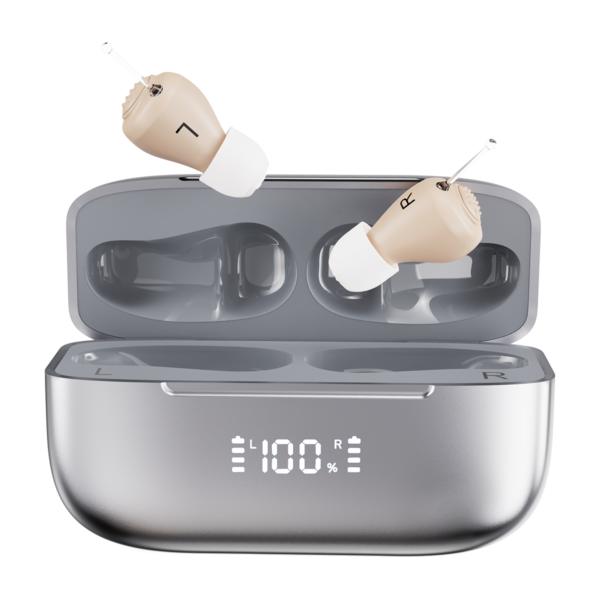
In-ear hearing aids, also known as in-the-ear (ITE) hearing aids, are custom-made devices that fit directly into the ear. An ITE hearing aid is designed to enhance hearing for individuals with varying degrees of hearing loss and offers flexible amplification ranges—from mild to severe—depending on the model and technology. Each ITE hearing aid can be professionally adjusted and programmed to meet personal listening needs, ensuring a precise and comfortable fit.
ITE hearing aid refers to in-ear solutions that include ITC, IIC, and CIC types. Most ITE hearing aid designs are compact and discreet, making them barely noticeable when worn. While smaller models of in the ear ITE hearing aids offer higher concealment, larger ITE hearing aids may be easier to insert or remove, particularly for users with limited dexterity. An ITE hearing aid is also simple to clean and maintain. Among them, IIC is the smallest ITE hearing aid, sitting deep inside the ear canal, while ITC and CIC devices are housed in micro-cases that fit partially or fully in the canal. Many users appreciate these styles for their convenience when using a telephone. However, due to their small size, IIC, CIC, and ITC devices can be harder to handle or adjust, may not suit smaller ears, and are typically recommended for adults with mild to moderate hearing loss.
The Difference between ITE hearing aid and BTE Hearing Aid
Regardless of whether it is ITC, IIC, CIC, or a full ITE hearing aid, their in-ear wearing style makes them fundamentally different from BTE models. Many users prefer a device that sits entirely inside the ear, a style commonly known as an ITE hearing aid or “in ear canal hearing aids.” Millions of users have adopted this style successfully, and an ITE hearing aid is often the first choice for new wearers due to its more discreet appearance.
When fitting BTE “Behind-the-Ear” models, greater power and amplification can be incorporated due to the larger housing, which is beneficial as a patient’s hearing loss progresses. This design also improves feedback control—reducing the whistling that may occasionally occur in an ITE hearing aid.
Choosing between an ITE hearing aid and BTE hearing aids depends on each customer’s needs. The ITE hearing aid style is more discreet, while BTE provides stronger amplification but is more visible. In general, children are recommended to use BTE models, while adults may choose between BTE and ITE hearing aid options based on personal preferences and hearing conditions.
In-the-ear (ITE) hearing aids (see Figure 3-9) are classified into ITE-full shell hearing aids that occupy the full ear cavity, as well as ITE-half shell and ITE-low profile designs depending on their position within the concha. An ITE hearing aid is one of the most widely used custom-made hearing solutions, and each ITE hearing aid must be produced with a personalized shell based on the user’s ear impression. As a result, many ITE hearing aid manufacturers provide multiple shell options to accommodate different patient anatomies.
There are also some concha-style hearing aids produced as fixed-size finished ITE hearing aid units. For these designs, the housing size cannot be changed, so the wearer must use a matching ear mold to embed the ITE hearing aid and ensure proper placement and comfort during use.
The basic structure of both the in-the-ear type and the ITE hearing aid is similar, consisting of a housing, microphone, integrated circuit amplifier, potentiometer, and receiver (see Figure 3-10). These components work together to deliver reliable amplification in compact in the ear ITE hearing aids commonly used in the market.
1.Shell
Both the ITE hearing aid and in-ear canal devices use a custom-made shell based on the patient’s ear canal shape (including the concha for in-ear models), which houses all internal components. The shell material must be non-toxic, hypoallergenic, stable, and resistant to temperature changes, with a smooth, impurity-free surface to ensure long-term durability—requirements that many ITE hearing aid manufacturers follow in production.
The housing of analog-style in-ear hearing aids may also include a volume controller, tone adjustment switch, maximum output limiter, and similar components. Some programmable ITE hearing aid or in-ear canal models incorporate program-switching buttons. Additionally, certain devices include an external pull cord for easier removal, along with a sound baffle positioned at the sound outlet.
2.microphone
Figure: ITE hearing aid

1-Volume control potentiometer
2-Microphone
3-Amplifier
4-Trimmer potentiometer
5-Shell
6-Receiver
Figure: Structure of ITE hearing aid and in ear canal hearing aids

Due to the larger form factor of the ITE hearing aid and in-ear canal devices, it is possible to install dual microphones, which enhances directionality and overall performance. In contrast, full ear-canal hearing aids are too compact to accommodate dual-microphone designs.
3.Integrated circuit amplifier
With the miniaturization of electronic components and higher circuit integration, the integrated-circuit amplifiers used in modern hearing aids—especially digital models—have become more advanced. Digital signal processing allows many functions to be added without increasing component count, making it possible to build smaller, more capable devices, including compact fully-in-canal models and advanced best ITE hearing aids equipped with upgraded processing features.
4.Battery
The ITE hearing aid typically uses an A13 battery, while in-ear canal devices use A312 batteries, and full-in-ear models use A10 or even A5 batteries. Some newer designs also support ITE rechargeable hearing aids, offering greater convenience for users who prefer rechargeable systems.
The resonance frequency of the adult external auditory canal is typically between 2000 and 4000 Hz, with theoretical averages of 3359 Hz for males and 3440 Hz for females. Measurements by Bu Xingkuan place the resonance at (2583 ± 323) Hz, with a peak gain around 2500 Hz reaching 11–12 dB.
When wearing an ITE hearing aid, the highest microphone-side peak shifts to roughly 5118–5638 Hz. Although the formant position changes, it still aligns with the natural resonance range of the ear canal and provides additional high-frequency compensation. This explains why an ITE hearing aid can meaningfully improve speech intelligibility.
The frequency-response peak of an ITE hearing aid is usually around 2500–2700 Hz, close to the normal outer-ear resonance. According to Gao Jianlin, the response range of the ITE hearing aid extends from approximately 200 to 7500 Hz—broad enough to cover the full speech frequency band. The curve remains smooth with minimal fluctuations, aligning well with natural auditory characteristics.
Gao Jianlin's experiments also show that ITE hearing aid and in-ear canal devices provide 25–33 dB of gain at 1000, 2000, and 4000 Hz, and 20–24 dB at 250–500 Hz, with the former offering slightly stronger compensation.
The folds of the human auricle act like multiple concave reflectors, increasing sound pressure at the microphone position. Since the microphone of an ITE hearing aid sits inside the ear rather than behind it, this natural acoustic effect enhances performance. Due to differences in ear-canal anatomy and device style, microphone sound gain varies across models. Experiments show microphone gain for ITE hearing aid ranges from 5.94 to 6.46 dB SPL, averaging (6.29 ± 1.09) dB SPL; in-ear canal devices show (8.08 ± 1.83) dB SPL; full canal models reach 8.80–9.30 dB SPL. These differences are structural rather than related to ITE hearing amplifier power output.
The advantages of ITE hearing aid compared to other custom styles include:
The power range of ITE hearing aid is generally 40 to 110 dB. Considering its acoustic characteristics and profile, ITE hearing aid is typically suitable for patients with moderate to severe hearing loss who prefer not to wear BTE hearing aids. Furthermore, as ITE hearing aid can easily integrate more advanced features, they are well-suited for users requiring higher hearing aid performance. For middle-aged or older adults with severe hearing loss and sufficient manual dexterity, ITE hearing aid is also a viable option. Many ite hearing aid manufacturers develop best ite hearing aids and ite rechargeable hearing aids within this category to meet diverse user needs.
ITE Hearing Aids
In-ear-canal hearing aids refer to a type of hearing device custom-made to fit the patient's external auditory canal, extending from the ear cavity to near the second bend.
Classification of Hearing Aids
In-the-canal (ITC) hearing aids are also custom-made devices. Unlike the standard ITE hearing aid which sits in the concha, ITC hearing aids are positioned within the ear canal itself. Based on size, canal hearing aids can be further categorized into in-the-canal (ITC), mini-canal (small ITC), and completely-in-canal (CIC) types. True completely-in-canal hearing aids must meet two specific criteria to be classified as such and to achieve optimal gain and output: First, the lateral face of the aid should be flush with or 1-2 mm inside the ear canal opening; second, the medial part should be within 5 mm of the eardrum. If a device fails to meet these criteria, it may only offer partial benefits of a deep fit and is more accurately termed a mini-canal hearing aid. The standard ITC hearing aid is also located in the ear canal but is slightly larger than both CIC and mini-canal models.
In ear canal hearing aids not only share the acoustic characteristics of ITE hearing aid but also align more closely with the physiological acoustic properties of the human ear, resulting in a superior hearing enhancement effect.
When a patient wears an in ear canal hearing aids, the frequency of the highest peak sound gain at the microphone ranges from 4733 to 5179 Hz. This is closer to the resonant peak frequency of the external ear canal found in individuals with normal hearing.
The external auditory canal is a hollow, blind-ended tube. Acoustic theory states that a closed tube resonates with and amplifies sound waves with a wavelength four times its length. For instance, a tube length of 2.5 cm corresponds to a resonant frequency wavelength of 10 cm. Calculating with a sound speed of 344 m/s, the resonant frequency is 3440 Hz. The air column in the tube resonates with sound waves of this frequency, increasing the sound pressure at the closed end.
In ear canal hearing aids occlude the external auditory canal, effectively shortening its length and shifting the formant frequency higher. This effectively amplifies speech frequency information, leading to significantly improved auditory resolution.
The primary physiological functions of the auricle are to orient, locate, collect, and amplify external sounds. The normal auricle collects sound, and its uneven surface structure causes differential reflections of sound sources from various directions and heights, plus a resonant amplification effect for specific frequencies. This filtering capability is crucial for sound source localization. As in ear canal hearing aids are positioned within the ear canal, they preserve more of the auricle's natural structure, thereby aiding in natural sound amplification and sound source localization.
Firstly, because the distance between the hearing aid's sound outlet and the eardrum is reduced, the amplified sound acts directly on the eardrum, minimizing distortion. Secondly, the placement of in ear canal hearing aids reduces the volume of the external ear canal cavity. According to the inverse relationship between volume and pressure, a smaller volume results in higher pressure. Consequently, wearing an in ear canal hearing aids increases the sound pressure level at the eardrum.
Compared with behind-the-ear and in-the-ear hearing aids, the advantages of in ear canal hearing aids include:
Currently, the power output of commonly used in ear canal hearing aids is generally suited for hearing loss up to 80 dB, with some high-power models from certain brands reaching 90-100 dB, though these are less common clinically. These devices are typically recommended for:
Younger individuals with mild to moderate hearing loss who have high demands for hearing aid cosmetics and performance.
Middle-aged and elderly individuals with mild to moderate hearing loss, good manual dexterity, and high requirements for both the hearing aid's effectiveness and appearance.
Patients with an average hearing loss below 80-85 dB. For those with a descending hearing loss curve (better low-frequency, poorer high-frequency hearing), in ear canal hearing aids can provide more effective high-frequency gain compensation.
A: An ITE hearing aid is designed to sit completely inside the outer ear. It uses a custom shell based on your ear canal shape to ensure comfort and secure placement.
A: Yes, as professional ITE hearing aid manufacturers, we offer comprehensive OEM and ODM services including shell customization, chip solutions, and logo printing.
A: Our best ITE hearing aids include noise-reduction DSP chips, rechargeable options, and invisible-fit designs, suitable for mild-to-moderate hearing loss.
A: Yes, we provide ITE hearing aids with Bluetooth, supporting phone calls, media streaming, and dual-ear pairing.
A: Certainly. We offer ITE hearing wholesale services with flexible MOQ and fast production time.


![Download our 2025 newest hearing aids product catalogue [PDF].](https://www.jhhearingaids.com/wp-content/uploads/2020/01/JINGHAO-Product-description-11.jpg "Download our 2025 newest hearing aids product catalogue [PDF].")